


From European Standards to Global Standards: A Faster, More Resilient, Future-Ready Neural Network for the Power Grid.
The next-generation narrowband power line carrier solution based on the PRIME v1.4 international standard achieves comprehensive leaps in speed, anti-interference, global frequency band adaptation, and IPv6 support, providing a powerful and reliable communication foundation for the global deployment of smart grids and diversified services.
Technology Areas
Communication / IoT
Pain Points and Challenges
- Geographical Limitations: Only supports the European CENELEC A frequency band, failing to meet the network access requirements of global markets such as the Americas (FCC) and Asia (ARIB), restricting overseas expansion.
- Environmental Vulnerability: Insufficient stability in harsh grid environments such as strong impulse noise, making it difficult to adapt to complex scenarios like medium-voltage distribution networks.
- Single Business: Originally designed for meter reading, it lacks support for high-bandwidth services, IP-based operations, and multi-device access, making it difficult to meet the evolving needs of smart grids.
Technical Principles
Based on the ITU-G.9904 international standard, a narrowband power line carrier communication system is built using OFDM core technology. Version 1.4 upgrades and optimizes on the mature architecture of v1.3.6: the physical layer expands the frequency band range, adds two robust transmission modes, introduces repetition coding technology, and optimizes parameters such as FFT to improve anti-interference capability and transmission rate; the MAC layer integrates time slot structure, optimizes superframe order, adds guard intervals, flexibly adjusts frame length and time slot length, adapts CSMA/CA algorithms with different parameter configurations, and adds a KeepAlive mechanism; the network layer adds IPv6 protocol support, enabling compatibility with various devices while maintaining backward compatibility with v1.3.6; the bottom layer builds a security protection system through 128-bit AES-CCM authentication encryption.
Innovation/Features
- Globalization & High Performance:
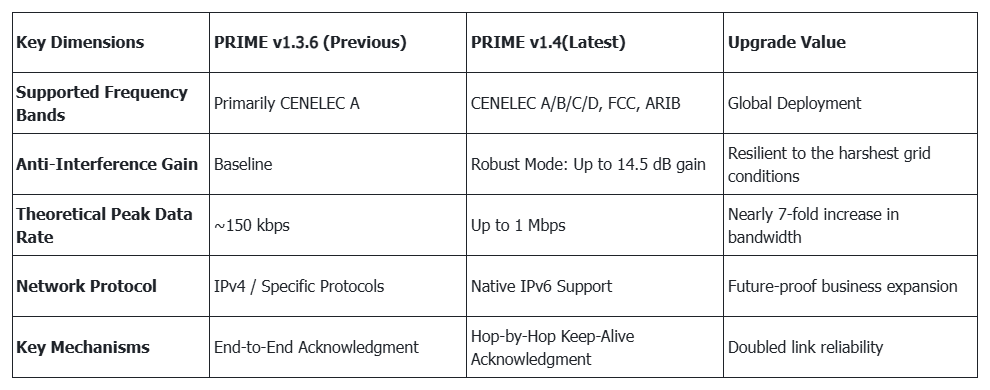
Global Frequency Pass: Frequency extended to 470kHz+, supporting CENELEC, FCC, and ARIB standards simultaneously—one solution fits the world.
Double Speed: Through multi-channel bonding and other technologies, the theoretical maximum rate is increased to 1Mbps, supporting richer data services. - Super Immunity & High Reliability:
Robust Transmission Mode: New Robust DBPSK/DQPSK modes, using repetition coding and other techniques, achieve up to 14.5dB performance gain in harsh noise environments, ensuring rock-solid communication.
Enhanced Link Maintenance: New hop-by-hop acknowledgment KeepAlive mechanism precisely locates and repairs weak links. - Future-Oriented Network Architecture:
Native IPv6 Support: Enables terminals such as meters to directly integrate into IP networks, paving the way for advanced applications like remote control and distributed energy monitoring.
Flexible Networking: Supports multi-channel scanning and binding, adapting to large-scale, complex topology distribution networks.
Key Performance Data
Scenario-Based Applications
Core Scenario 1: Global Smart Grid Construction and Renovation
Value: Whether in Europe, the Americas, or Asia, a single v1.4 solution meets local regulatory requirements, greatly simplifying the R&D and certification process for multinational products.
Core Scenario 2: Advanced Metering and Distribution Automation in Complex Environments
Value: In medium-voltage distribution networks with industrial interference or remote areas, its robust mode ensures 100% delivery of critical commands such as power outage alerts and remote switching, making it a reliable channel for distribution automation.
Core Scenario 3: Future-Oriented Integrated Energy Services
Value: With IPv6 support and higher bandwidth, it not only enables meter reading but also serves as a data pipeline connecting home energy routers, EV Chargers, and photovoltaic inverters, supporting smart energy management.
Trust Endorsement
Standard Authority: Strictly complies with the ITU-G.9904 (PRIME) international standard and holds the official PRIME Alliance certification certificate.
Commercial Success Cases: Applied in international projects such as the Spain Viesgo Smart Meter Project, verifying its stability and advanced performance in real grid environments.