


Smart Dispatch · Cost Reduction & Compliance · Safe Backup Power, Building a Green Home Energy Ecosystem.
An all-in-one home energy management device integrating PV, storage, EV chargers, diesel generators, and home loads. Through dynamic electricity price arbitrage, PV self-consumption optimization, anti-backflow compliance control, and millisecond-level backup power switching, it achieves low-cost, high-safety, and high-efficiency home electricity operation, adapting to global multi-regional policies and usage scenarios.
Technology Areas
Home Energy Management
AI Prediction & Dispatch
Pain Points and Challenges
1. High energy costs: Global electricity price fluctuations intensify, with significant peak-valley spreads, making it difficult for traditional energy consumption models to precisely optimize costs.
2. Difficulty adapting to dynamic electricity prices: Multi-period electricity prices fluctuate rapidly with complex rules, and manual scheduling cannot capture arbitrage opportunities in real time.
3. Poor photovoltaic (PV) self-consumption: Distributed PV generation is unstable, surplus power fed into the grid is limited, and low self-consumption rates lead to reduced revenue.
4. Strict grid constraints: Some regions mandate anti-reverse power flow requirements, with penalties for non-compliance.
5. Insufficient power supply reliability: Grid outages cause core loads to lose power, highlighting the need for emergency backup.
6. Weak equipment coordination: Solar, storage, EV chargers, and various household loads operate in a decentralized manner without unified scheduling, resulting in low energy efficiency.
7. High compliance and compatibility barriers: Diverse regional metering and safety standards, and difficulty integrating third-party equipment.
Technical Principles
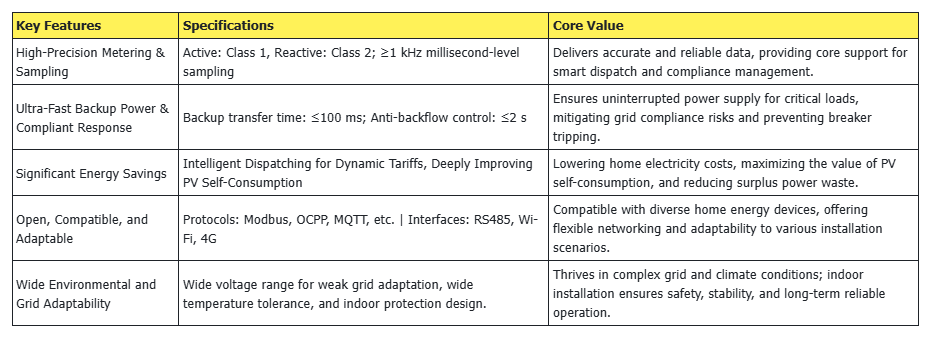
Adopting a “Cloud-Edge-Device Collaboration” architecture, the edge side (HEMS terminal) uses a hard metering chip with ≥1kHz millisecond-level sampling to achieve high-precision data acquisition. Combined with AI prediction algorithms (PV/load/weather) and dynamic electricity prices, real-time energy allocation is completed. The cloud is responsible for dynamic electricity price access, strategy optimization, and VPP command response. It integrates multi-protocol compatibility to enable coordination among PV, storage, charging, and various loads. It achieves millisecond-level grid-feed power monitoring and zero-feed control, automatic dynamic electricity price identification and peak-valley arbitrage algorithms, load-priority-based intelligent scheduling, and ultra-fast grid outage switching logic, while meeting global mainstream metering and safety compliance standards.
Innovation/Features
1. Fast Response: Anti-backflow response ≤2s, grid interruption switching ≤100ms, ensuring compliance and power supply continuity;
2. Full-Scenario Load Control: Supports EV chargers (OCPP protocol), heat pumps, smart sockets, and other load types, adapting to different household energy needs;
3. Automatic Strategy Generation: AI algorithm automatically identifies dynamic electricity price periods without manual settings, generating optimal charging/discharging and load control strategies;
4. Open and Compatible Design: Supports mainstream protocols such as Modbus TCP, MQTT, OCPP 1.6/2.0.1, easily integrating with third-party devices, breaking closed system limitations;
5. Full Compliance Coverage: Meets global mainstream standards such as IEC 62052, EN 50470, GDPR, CRA, directly deployable in multiple regions;
6. Intelligent Predictive Scheduling: Integrates multi-dimensional predictions of PV, load, weather, and electricity prices, achieving adaptive learning scheduling and continuously optimizing energy efficiency.
Key Performance Data
Scenario-Based Applications
1. Dynamic Electricity Price Arbitrage Scenario: AI identifies peak and off-peak electricity prices, automatically stores energy during off-peak hours, and prioritizes using stored energy for power supply during peak hours. It also coordinates with devices such as EV chargers and heat pumps to operate during off-peak times, maximizing price differences to reduce electricity purchase costs.
2. Maximized Photovoltaic Self-Consumption Scenario: Solar power is prioritized for immediate household loads, with surplus electricity automatically stored in energy storage devices, avoiding revenue loss from feeding excess power back to the grid, thereby deeply enhancing the utilization rate of solar resources.
3. Grid Outage Backup Scenario: In the event of a sudden power outage, it quickly switches to backup power mode, prioritizing continuous power supply to critical loads such as medical equipment, refrigerators, and lighting. Once the grid is restored, it automatically switches back to normal mode without manual intervention.
4. VPP Aggregation Participation Scenario: Responding to aggregator dispatch commands, while ensuring household energy needs, it aggregates distributed resources such as photovoltaics and energy storage to participate in grid peak shaving and frequency regulation services, creating additional revenue for users.
Trust Endorsement
Technical compliance advancement: adapt to IEC 62052, EN 50470-1/3 (Europe), INMETRO (Brazil) and other metering standards according to regional requirements, and promote cybersecurity and electrical standard adaptation;
Technical accumulation: integrate core technologies such as photovoltaic-storage-charging coordinated control and AI predictive scheduling, compatible with mainstream protocols like OCPP and MQTT, and have completed functional verification for multi-regional scenarios.