


Gain insight into energy usage, control peak demand and reduce costs, and optimize investment returns.
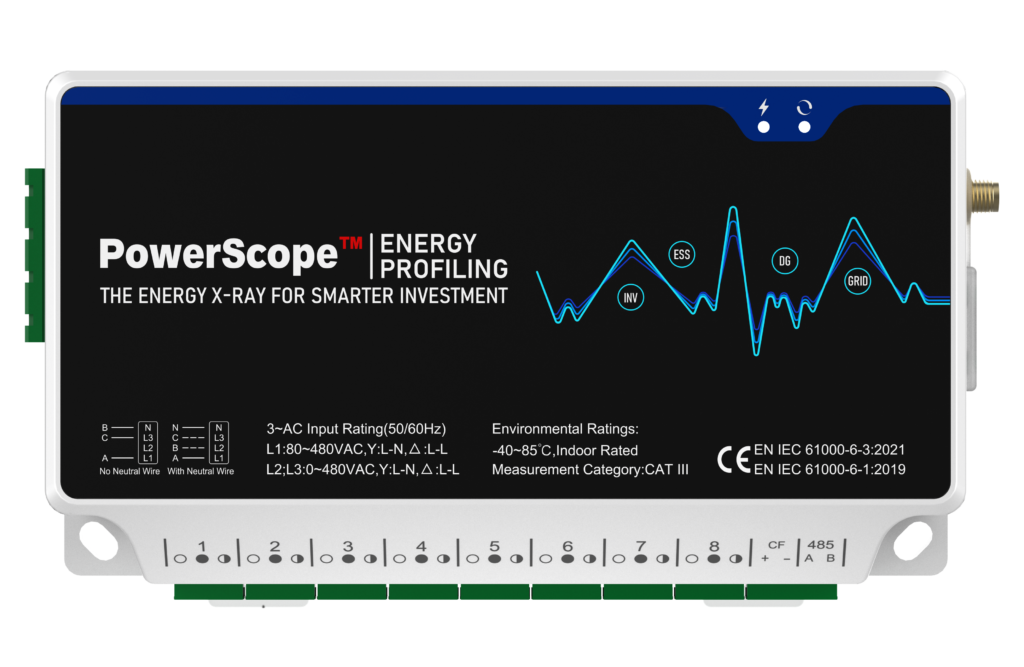
Centered on multi-circuit precision monitoring, it integrates five capabilities: real-time data acquisition, energy consumption analysis, intelligent diagnostic alarms, curve export, and ROI analysis, building a full-chain integrated solution from energy collection to storage calculation.
Technology Areas
Energy Monitoring and Diagnosis
R&D Approach
Self-developed
Pain Points and Challenges
1. EPC Solution Design: Influenced by differences in users’ electricity consumption environment, patterns, and demand/investment willingness, solution design relies on empirical assessment and lacks precise energy usage data support, which can easily lead to over- or under-investment and significantly increases the difficulty of implementing the solution.
2. Equipment Operation Risks: Load surges and harmonic interference can easily cause inverter/PCS downtime. Traditional equipment lacks predictive capabilities and cannot avoid such operational risks.
3. Demand Management: Demand forecasting lacks support from long-term curve data, making it difficult to formulate accurate and effective electricity optimization strategies.
4. Residential Management: Traditional single-circuit meters cannot meet the refined management needs of “per device, per time period.” The lack of full-chain energy consumption visualization makes it difficult to identify standby energy consumption and optimize the self-consumption rate of photovoltaics.
5. Commercial and Industrial Energy Management: Commercial buildings suffer from uneven energy consumption among multiple loads, while industrial workshops lack production line energy efficiency monitoring and fault warning capabilities. Both make it difficult to allocate energy costs, optimize equipment maintenance, and effectively identify potential energy waste.
6. Sensor Adaptation: Sensors need to be manually configured in different scenarios, resulting in cumbersome operation processes and high implementation barriers.
7. Data Integration: Data is stored in a decentralized manner, making it impossible to effectively integrate with ROI analysis and demand management systems, thus hindering digital decision-making.
Technical Principles
1. Metering-grade sampling: CT + dual AD7606 chip synchronous acquisition, compliant with ANSI C12.20 and IEC 62053 standards, active power accuracy 0.5%;
2. Intelligent processing: T536 heterogeneous core runs core algorithms such as sensor adaptation, anomaly diagnosis, and intelligent alarm;
3. Autonomous data management: local multi-granularity storage, no subscription fee, supports CSV export;
4. Full-function closed loop: integrates energy visualization, intelligent alarm, custom dashboard, and oscilloscope functions, covering dual scenarios;
5. Solution empowerment: integrates ROI algorithm, links with platform to realize energy storage configuration calculation, supporting EPC data-driven decision-making.
Innovation/Features
1. Precision Monitoring: Achieves metering-grade accuracy of 0.5% for active power (ANSI C12.20 standard) and 2% for reactive power (IEC 62053 standard), enabling fine-grained monitoring of each circuit via current transformers (CTs).
2. Integrated Functionality: Extends from single data collection to a closed loop of “real-time collection – energy analysis & statistics – intelligent anomaly diagnosis – green energy adaptation,” rejecting fragmented functions while covering both residential and commercial/industrial scenarios.
3. Autonomous Access: “No subscription fee + local storage + remote access,” giving users data autonomy.
4. Solution Enablement: EPC contractors require an integrated tool for “load collection before energy storage commissioning + curve analysis + ROI calculation + capacity configuration,” replacing subjective guesses with actual data to enhance solution credibility.
Key Performance Data
| Key Features | Specifications | Core Value |
|---|---|---|
| High-Precision Multi-Circuit Measurement | 8 current channels + 3 voltage channels; CT active power 0.5%, reactive power 2%, Rogowski coil active power 2%, reactive power 5% | Ensures accurate load assessment for solar-storage solutions, avoiding over/under investment |
| Multi-Dimensional Data Acquisition | ns-level inrush current recording + 51st harmonic analysis; 1-second to 15-minute multi-granularity storage (up to 30-year traceability) | Covers all power usage conditions, enabling early prediction of equipment downtime/harmonic interference risks |
| Decision Support for Solar-Storage Solutions | Integrates with ROI platform for automatic energy storage configuration; paired with storage to shorten payback period | Replaces experience with data, scientifically formulates solar-storage solutions, improving energy project profitability |
Scenario-Based Applications
Core Scenario 1: Residential Energy Monitoring
Value: In residential scenarios with PV, storage, and EV chargers, traditional single-loop meters cannot meet the need for granular management by device and time period. PowerScope™ Energy Profiling enables full-chain energy visualization, identifies standby energy consumption, and optimizes PV self-consumption rate.
Core Scenario 2: Commercial & Industrial Energy Monitoring
Value: For commercial buildings (uneven multi-load energy consumption) and manufacturing workshops (lack of production line energy efficiency/fault monitoring), PowerScope™ Energy Profiling supports energy cost allocation and equipment O&M optimization through multi-loop data, while identifying potential energy waste.
Core Scenario 3: EPC Commercial Energy Data Collection & Solution Design
Value: For EPC commercial PV-storage solution design, where diverse user environments and needs make design challenging, PowerScope™ Energy Profiling collects energy usage data and load characteristics, and together with the ROI platform, empowers PV-storage solution design, reducing design difficulty and expanding business scale.
Trust Endorsement
Standard Authority: Complies with international standards such as IEC 61000-6-1/3, IEC 61010-1, EN 300328, EN 62311, and has CE certification (LVD/EMC directives).
Commercial Success Cases: Applied in factories, hotels, mining, agriculture, and other scenarios in Africa, Asia, Latin America, and other regions, proven to be stable and reliable.