

Breaking the energy dilemma with intelligent dispatch, creating triple value (energy efficiency + cost + carbon emissions) through collaborative optimization
Focusing on complex industrial and commercial energy consumption scenarios, with multi-energy supply-demand intelligent dispatch as the core, dynamically matching production-consumption rhythms, optimizing distributed energy and storage configurations, achieving precise energy control, and ensuring energy security and stability.
Technology Areas
Industrial and Commercial Energy Management
Pain Points and Challenges
1. Data silos: Energy status is “invisible and intangible,” making it impossible to build a full-chain energy flow view of “source – grid – load – storage.”
2. Passive control: Unable to implement automated strategies, lack of monitoring of equipment operation status, failure to meet grid-side requirements for distributed energy integration, facing restrictions on grid connection or fines.
3. Revenue loss: Charging and discharging at fixed times misses optimal arbitrage windows, high demand charges, inability to identify inefficient energy-consuming equipment or unreasonable energy usage periods, resulting in severe energy waste.
4. Inefficient O&M: No remote O&M capability, high manual O&M costs, lack of data-driven O&M optimization.
Technical Principles
Based on the cloud-edge collaboration + source-grid-load-storage integrated architecture, relying on multiple interfaces and standardized protocols to achieve global energy data collection. On the cloud or edge side, AI and optimization algorithms, combined with electricity prices, carbon targets, and grid constraints, generate scheduling strategies such as peak shaving and valley filling, photovoltaic-storage coordination, and demand control. Through a closed-loop control chain, commands are issued to execution devices, and simultaneously, through multi-level security protection design, the “strong grid strategy” maximizes the economic value of energy storage, the “weak grid strategy” ensures power supply quality and stability, and the “isolated grid strategy” maintains system survival and operation.
Innovation/Features
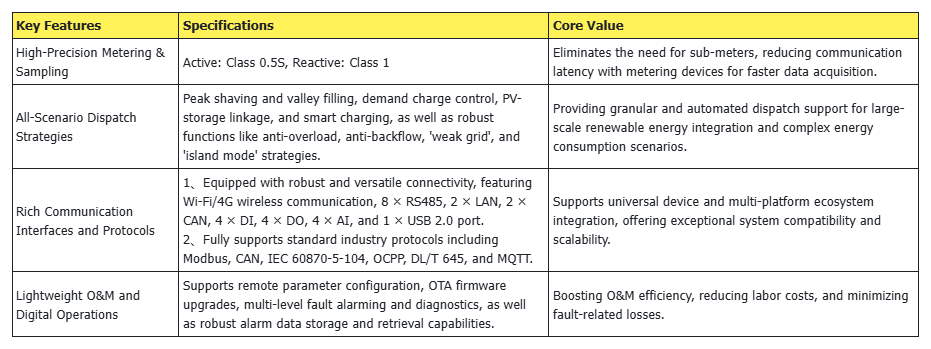
1. Full-scenario intelligent dispatch: Supports photovoltaic inverters, energy storage, EV chargers, diesel generators, and other full-scenario commercial and industrial energy management systems.
2. Open and compatible design: Supports mainstream protocols such as Modbus TCP, MQTT, OCPP 1.6/2.0.1, easily integrating with third-party devices, breaking the limitations of closed systems.
3. Demand control: Through a three-level optimization architecture consisting of “first-level prediction, second-level optimization, third-level control,” it can predict the initial monthly demand control target based on historical data without manual setting. During demand control, it can adaptively adjust the demand control target based on load and energy storage status, improving the success rate of demand reduction.
4. Intelligent predictive dispatch: Integrates multi-dimensional predictions of photovoltaic, load, weather, and electricity prices to achieve adaptive learning dispatch, continuously optimizing energy efficiency.
Key Performance Data
Scenario-Based Applications
1. Peak Shaving and Valley Filling: Respond to time-of-use electricity price signals, manage energy based on price changes, and maximize the system’s full lifecycle economic benefits.
2. Demand Control: Through a three-level optimization architecture consisting of “first-level prediction, second-level optimization, third-level control,” achieve refined power management from macro planning to micro execution.
3. Solar-Storage Coordination: Based on user actual needs, maximize user benefits through TOU peak-valley arbitrage and demand management strategies.
4. Overload Prevention: Ensure the total grid load remains within safe thresholds through real-time monitoring and dynamic adjustment, guaranteeing operational safety.
5. Reverse Power Prevention: Monitor and regulate power to prevent excess electricity from distributed energy sources from flowing back into the grid.
6. Weak Grid Strategy: Automatically and seamlessly switch between grid-connected and off-grid modes based on real-time changes in grid connection status, ensuring continuous and reliable power supply to user-side loads while maximizing renewable energy utilization and system economic benefits.
7. Island Grid Strategy: Prioritize self-consumption of photovoltaic power, combined with energy storage and diesel generator graded power supply strategies, to maintain system survival and operation.
Trust Endorsement
Standard Authority: Complies with international standards such as N301489-1/17/52,
EN61010-1, EN62311, and has obtained CE certification, ROHS certification, RED cybersecurity certification, REACH SVHC certification, WEEE certification, and UL testing.
Complete Solution Delivery: Provides a complete solution from device hardware to software platform.
Commercial Success Cases: Applied by customers in Africa, Asia, Latin America, Europe, and other regions; the solution is reliable and stable.