


High-precision metering capability, full-scenario adaptability, enabling precise power supervision and efficient electricity utilization.
Achievement Description
Integrating 0.2S ultra-high precision metering, panoramic power quality analysis, and full-scenario adaptive capabilities, it is specifically designed for gateway settlement, high-end commercial and industrial applications, and key nodes of new power systems, achieving a value leap from “precise billing” to “deep perception”.
Technology Areas
Smart Meter
Pain Points and Challenges
Value Measurement Deficiency
Traditional meters only record basic active power, failing to precisely measure “invisible costs” such as reactive power and harmonics that degrade grid efficiency and shorten equipment lifespan. This leads to unfair settlements and blind spots in energy efficiency management.
Poor Scenario Adaptability
When facing complex wiring configurations (3-phase 3-wire / 4-wire), wide voltage fluctuations, and harsh climatic environments, conventional meters suffer from decreased reliability and metering inaccuracies, undermining trade fairness and the authenticity of grid data.
Escalating Regulatory and Safety Demands
With the high-penetration integration of renewable energy, grids urgently require precise perception of power quality issues like harmonics and voltage sags. However, traditional meters lack sufficient analytical capabilities to support safety early warnings and compliance supervision.
Technical Principles
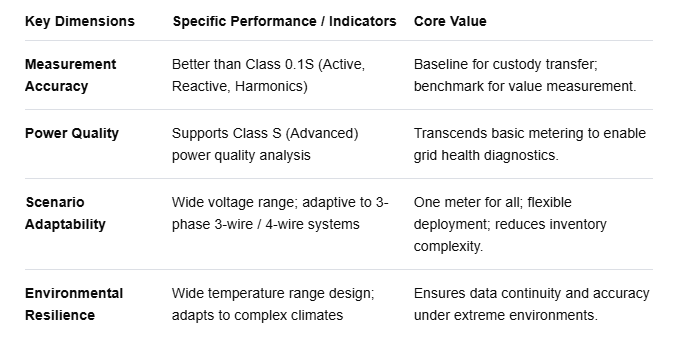
By leveraging advanced metering algorithms and precision sampling technology, this product achieves a benchmark accuracy surpassing Class 0.2S across a wide voltage range. Its hardware platform features wiring self-adaptability and wide-temperature-range operability, while the software embeds a Class S power quality analysis module that monitors dozens of electrical parameters and events in real time—upgrading the meter from a mere billing terminal into a comprehensive grid-state perception node.
Innovation/Highlights
- Revenue-Grade Precision Metering
Features Class 0.2S full-element metering for active power, reactive power, and harmonics, meeting the ultimate precision requirements of gateway revenue settlement for large substations and ensuring trade fairness. - Panoramic Perception and Diagnosis
Integrates Class S power quality monitoring to precisely analyze harmonics, interharmonics, voltage swells/sags, and flicker, serving as the data foundation for grid security, equipment O&M, and energy efficiency optimization. - All-Scenario Resilience and Reliability
Engineered with a wide voltage range and a 3-phase 3-wire/4-wire self-adaptive design, the device seamlessly adapts to diverse grid wiring scenarios. Leveraging high-reliability architecture and advanced material processing, it withstands harsh climatic environments—including extreme temperatures and humidity—to guarantee long-term stable operation.
Key Performance Data
Scenario-Based Applications
Core Scenario 1: Gateway Metering for Power Trading
Value Deliverables: Deployed at key custody transfer points such as inter-provincial tie lines, grid-connection points of large-scale power plants, and ultra-high-voltage (UHV) substations. Its Class 0.2S precision serves as the statutory baseline for electricity tariff settlement, directly safeguarding the fairness and equity of monumental fund flows.
Core Scenario 2: Lean Management for High-End Commercial and Industrial & Commercial (I&C) Users
Value Deliverables: Provides data centers, high-end manufacturing facilities, and large commercial complexes with precise insights into peak-valley-flat electricity usage, reactive power losses, and harmonic pollution. This empowers users to pinpoint energy efficiency vulnerabilities, optimize power supply contracts, and eliminate power factor penalty charges, ultimately driving down costs and enhancing operational efficiency.
Core Scenario 3: Power Quality Regulation for Next-Generation Power Systems
Value Deliverables: Deployed as power quality monitoring terminals at centralized grid-connection points for solar and wind power, or on the sensitive industrial load side. It precisely captures and logs events such as voltage fluctuations and harmonic non-compliance, providing actionable governance data for utility companies to facilitate renewable energy integration and safeguard grid security and stability.
Trust Endorsement
Standard Compliance: Fully complies with international standards, including IEC 62053-22, IEC 62053-24:2020, and IEC 62052-31:2015.
Authoritative Certification: Officially certified under the MID (Measuring Instruments Directive).