


One Chip, Dual Mode, Deep Integration: Providing Uninterrupted Reliable Connections in Complex Environments
A self-developed broadband power line carrier (PLC) and radio frequency (RF) dual-mode communication chip, using physical layer deep integration technology to overcome signal blind spots and interference challenges, fully meeting the high-reliability communication needs of smart grids and the Internet of Things.
Technology Areas
IoT
R&D Approach
Independent Innovation
Pain Points and Challenges
Limitations of Single-Mode Communication: In power grids or complex industrial scenarios, a single communication method (e.g., wired or wireless) is susceptible to environmental interference and obstructions, leading to communication blind spots and data interruptions.
Shortcomings of Traditional Dual-Mode: Early dual-mode solutions were often “glued” together, resulting in high switching latency, high power consumption, and complex hardware.
Demanding Environmental Requirements: Communication equipment must remain stable under extreme temperatures and strong interference while meeting strict industry standards.
Technical Principles
This chip is not a simple combination; instead, it natively integrates broadband PLC and multi-band RF modules on a single 40nm CMOS die, sharing the processor and memory. Using OFDM modulation technology and a self-developed cooperative communication protocol, it achieves dual-mode concurrency, redundant backup, and intelligent switching, solving integration and reliability issues at the physical layer.
Innovation/Features
- True Integration, High Reliability:
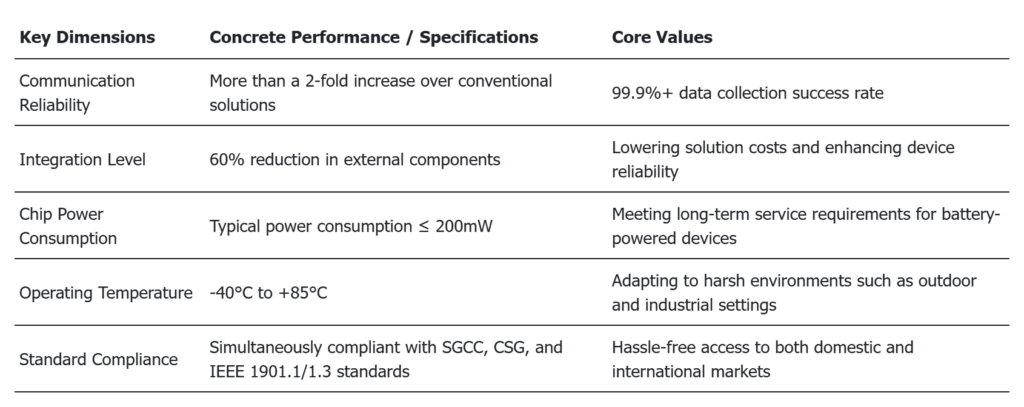
Single-Chip Dual-Mode Design: Breaks through tradition, achieving native integration of PLC and RF at the hardware level, with seamless switching and over 2x improvement in communication reliability.
Collaborative Communication Protocol: Supports synchronous data transmission and redundant backup, ensuring critical commands are never lost. - Strong Anti-Interference, Adaptive:
Dynamic Anti-Interference Algorithm: Built-in 400MHz low-phase-noise PLL and highly stable reference source, combined with Dynamic Subcarrier Allocation (DSA) algorithm, to avoid power line noise in real time, improving subcarrier utilization by 30%.
Dual-Mode Complementarity: Wired and wireless complement each other, significantly enhancing communication adaptability in harsh channel environments (e.g., low SNR). - High Integration, Wide Compatibility:
Minimalist Design: Single-chip integration of communication, security, and power management reduces peripheral components by 60%, with chip area ≤13mm².
Multi-band Global Compatibility: Wireless supports multiple frequency bands including 470-928MHz, operating temperature -40℃~85℃, meeting deployment requirements across different regions and complex environments worldwide.
Key Performance Data
Scenario-Based Applications
① Smart Grid Scenario: Adapt to grid projects such as State Grid and China Southern Power Grid to achieve stable communication and data transmission within the station area, support mixed operation, and ensure efficient grid dispatching and monitoring services;
② Industrial IoT Scenario: Achieve precise communication between devices in harsh industrial environments, supporting industrial production data collection and command transmission;
③ Environmental Monitoring Scenario: Relying on strong anti-interference and wide temperature adaptation characteristics, stably transmit monitoring data in complex environments;
④ Smart Home Scenario: Through low-power, high-reliability communication, achieve interconnection and intelligent control of home devices.
Trust Endorsement
① Authoritative Compliance: Meets domestic and international industry standards such as State Grid, China Southern Power Grid, IEEE 1901.1, and IEEE 1901.3;
② Project Validation: Successfully applied in projects including China Southern Power Grid, State Grid, Mengxi Power Grid, and Tajikistan, rigorously validated in real-world scenarios;
③ Technology Property: Owns proprietary intellectual property, with core technology having independent R&D advantages.